
Explainable By Design
Most Decision Engines Return Answers. CLE Shows The Decision.
Many business decisions need to be understood long after they have been executed.
- A pricing decision may be questioned by a sales representative.
- A validation result may need to be reviewed by a support team.
- An approval outcome may need to be explained to an auditor.
Knowing the result is often not enough.
Organizations also need to understand how the result was produced.
See The Decision Behind The Result
Instead of exposing only the final outcome, CLE can expose the evaluated state of the decision model itself.
The decision model remains visible after execution. Inputs, lookup results, intermediate calculations and decision outputs can be inspected directly inside the evaluated model.
This allows business experts and developers to understand not only what was decided, but why it was decided.
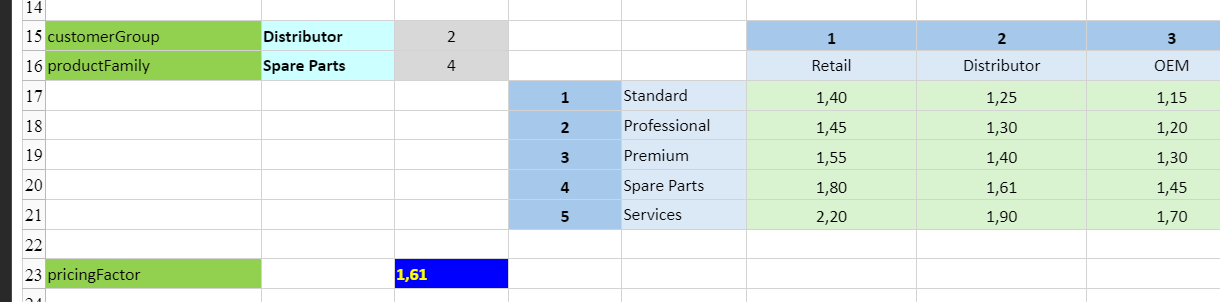
Most decision engines can show the result.
CLE can show the evaluated decision model that produced the result.
The Evaluated Model Becomes Visible
CLE does not return only the final decision result.
CLE can render the evaluated state of the decision model as an HTML decision view. The original model remains visible, populated with the values used during execution.
Business experts can inspect:
- Input values received from the application
- Lookup results and reference data
- Intermediate calculations
- Dependencies between decision elements
- Final outputs and decision results
The result is not only returned. The decision model that produced it can be inspected.
From JSON To Decision View
Applications submit the business object used for the decision. CLE returns the evaluated decision model as an HTML decision view.
POST /api/decision2html
Content-Type: application/json

{{
  "customerGroup": "Distributor",
  "productFamily": "Spare Parts"
}]
CLE evaluates the compiled dependency graph and returns a self-contained HTML representation of the evaluated decision model. The view includes the input values, lookup results, intermediate calculations and outputs used for that specific execution. It can be displayed directly in a browser or embedded in an application for debugging, review and support purposes.
The Workbook Is Not Executed
The rendered HTML view is not generated by Excel.
CLE evaluates the compiled dependency graph and renders the resulting model state as HTML. No Excel installation is required, and no workbook is executed for each request.
The Excel workbook remains the modeling environment. CLE remains the decision runtime.
From Black Box To Transparent Decision
Many decision systems expose only inputs and outputs.
When a result is questioned, the decision process remains hidden.
CLE takes a different approach.
The evaluated decision model can be inspected directly, making the decision process visible and understandable.
For Developers And Business Experts
Different audiences need different levels of visibility.
- Business experts want to verify calculations, lookup tables and decision paths.
- Developers want to understand how input data affected the final result.
- Support teams need to explain decisions.
- Auditors need to verify them.
The same evaluated decision model can provide the context required by all of them.
Understand Why
A decision result is often just a number, a status or a Boolean value.
CLE makes the model, calculations and dependencies behind that result visible.
Understand not only what happened. Understand why.