
Turn Excel Pricing Models Into APIs
The Problem Is Not The Pricing Model
Most organizations already have pricing models.
The problem is making pricing decisions available across ERP systems, CPQ platforms, ecommerce applications and customer portals.
CLE turns existing Excel pricing models into reusable pricing APIs, allowing organizations to reuse pricing models across ERP, CPQ, ecommerce and customer portals. The pricing API is implemented as a Decision Engine API that executes pricing decisions from Excel-based decision models.
Business experts maintain pricing models. Applications consume pricing decisions.
Why Pricing Models Stay In Excel
Most pricing models start in Excel for a simple reason. Excel allows pricing teams to create, test and maintain reusable pricing logic without software projects. Over time these workbooks become the most valuable pricing asset inside the organization.
They contain years of accumulated business knowledge:
- customer agreements
- discount matrices
- quantity tiers
- margin calculations
- product group pricing
- regional pricing rules
- currency conversion
- special exceptions
The problem is rarely the pricing model itself.
The problem is making that pricing logic available across ERP systems, CPQ platforms, e-commerce applications, customer portals and custom software.
CLE turns Excel pricing models into reusable pricing APIs.
Business experts continue maintaining pricing models in Excel.
Applications consume pricing decisions through REST APIs.
Learn how CLE exposes business decisions through a Decision Engine API.
Real-World Pricing Models Are Full Of Lookup Tables
Most pricing models are not built from simple IF statements.
They contain pricing matrices, customer-specific agreements, product family adjustments and lookup tables that have evolved over many years.
A common example is a pricing factor matrix based on customer groups and product families.
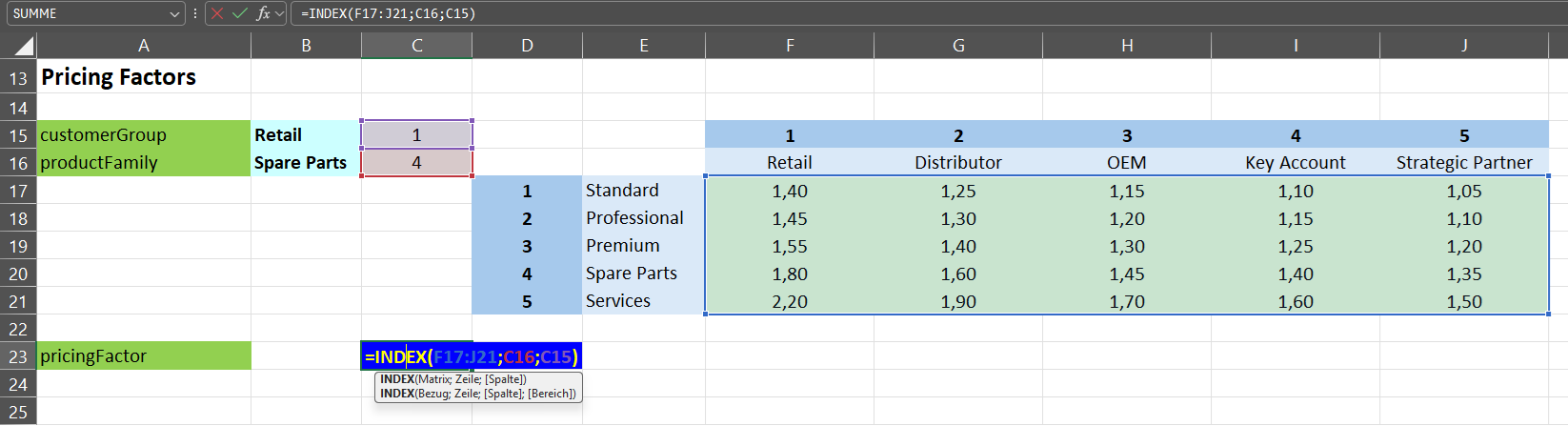
The business user thinks in pricing matrices.
Applications simply provide customer groups and product families.
CLE executes the Excel model and returns the resulting pricing factor.
Pricing Should Be A Service
Pricing decisions are needed everywhere:
- ERP systems
- CPQ solutions
- E-commerce platforms
- Customer portals
- Procurement systems
- Product configurators
- Custom applications
Instead of rebuilding pricing logic in every application, organizations can expose a single pricing service.
flowchart TD

    ERP[ERP System]
    CPQ[CPQ Platform]
    COM[E-Commerce]
    PORTAL[Customer Portal]
    PROC[Procurement System]
    PIMC[PIM systems<br/>e.g. Pimcore]

    API["Pricing API<br/>CLE"]

    MODEL["Excel Pricing Model"]

    ERP --> API
    CPQ --> API
    COM --> API
    PORTAL --> API
    PROC --> API
    PIMC --> API

    API --> MODEL

    classDef model fill:#FFF9C4,stroke:#D4AF37,color:#000;
    classDef api fill:#FFDFE5,stroke:#FF5978,color:#8E2236;

    class MODEL model;
    class API api;
One pricing model.
One source of truth.
Every application receives the same pricing decision.
The Problem With Pricing Logic In Application Code
Most organizations eventually outgrow manual spreadsheet workflows.
As pricing logic spreads across ERP systems, CPQ platforms, webshop integrations and custom applications, every change becomes a software project.
- The same discount matrix is implemented multiple times.
- The same pricing rule is maintained in multiple systems.
- The same business logic produces different results.
Pricing becomes harder to maintain, harder to explain and slower to change.
CLE centralizes pricing decisions in a single executable pricing model.
Pricing API Example
The following request uses the pricing matrix shown above. For a Retail customer purchasing Spare Parts, the Excel pricing model returns a pricing factor of 1.80. The resulting pricing factor is then used to calculate the final customer price.
Request
POST /api/decision
Content-Type: application/json

[{
  "customerGroup": "Retail",
  "productFamily": "Spare Parts",
  "quantity": 250,
  "purchasePrice": 85.50,
  "currency": "EUR"
}]
Response
HTTP 200 OK

[{
  "customerGroup": "Retail",
  "productFamily": "Spare Parts",
  "quantity": 250,
  "purchasePrice": 85.50,
  "currency": "EUR",
  "pricingFactor": 1.80,
  "retailPrice": 153.90,
  "tierLevel": 3
}]
Applications send business data.
CLE returns pricing decisions.
Pricing Logic is executed by the CLE Decision Engine API.
Real-Time Pricing From Existing Models
Modern applications cannot depend on manual spreadsheet execution.
Customers expect immediate responses.
Sales teams require instant quotations.
Commerce platforms need pricing decisions in real time.
CLE executes existing Excel pricing models through REST APIs.
No exports.
No imports.
No manual calculations.
No duplicated pricing logic.
Keep Existing Excel Pricing Models
Most pricing models already contain years of business knowledge.
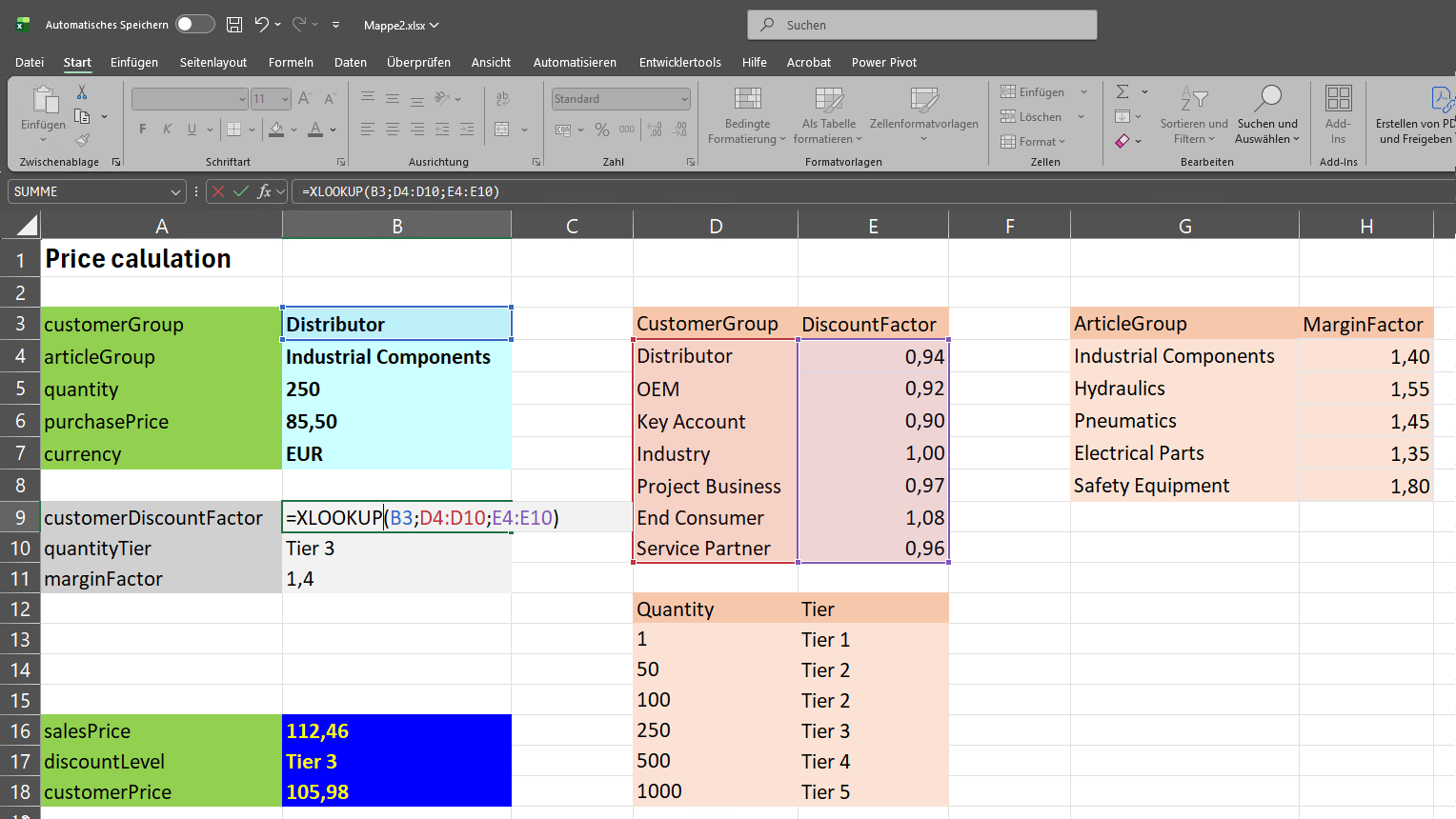
Typical models include:
- IF formulas
- XLOOKUP
- VLOOKUP
- INDEX/MATCH
- SUMIFS
- customer-specific pricing
- quantity discounts
- pricing matrices
- regional pricing tables
CLE allows organizations to keep these Excel pricing models.
One Pricing Model. Every Application.
A single pricing model can power:
- ERP
- CRM
- CPQ
- E-Commerce
- Procurement
- Customer Portals
- Internal Applications
Every system receives pricing decisions from the same model.
No duplicated calculations.
No inconsistent pricing.
No synchronization projects.
Explain Every Price
Pricing decisions should never be black boxes.
Every calculated result can be traced back to:
- input values
- customer groups
- quantity tiers
- discount matrices
- margin factors
- lookup tables
- exchange rates
- intermediate calculations
Business users, developers and auditors can understand exactly how a customer price was generated.
Why Organizations Use CLE For Pricing
Keep Existing Pricing Models
Continue using the models the business already trusts.
Real-Time Pricing APIs
Deliver pricing decisions instantly to any application.
Faster Business Changes
Update pricing logic without modifying application code.
Consistent Pricing Everywhere
Use the same pricing model across all systems.
Explainable Pricing Decisions
Understand how every price was calculated.
Lower Technical Debt
Remove pricing logic from application code and integration workflows.
Excel Pricing Models As APIs
Applications own the data.
Business experts own the pricing model.
CLE executes pricing decisions.
Keep the pricing model. Replace the runtime.