
Excel Rater API
Turn Excel Rating Models Into Production-Ready APIs
Maintain rating logic in Excel. Expose it through APIs. Eliminate logic drift.
Use existing Excel rating models across underwriting systems, broker portals, customer applications and integrations without rewriting formulas in application code.
Excel stays with the business team.
JSON stays with the developer.
The rating model remains the source of truth.
Why Excel Rating Models Become a Problem
Insurance rating models rarely start as large, enterprise-scale assets. Most begin with a few rating factors, some lookup tables and a handful of premium calculations maintained by product specialists, underwriters or actuaries. Over time those spreadsheets evolve into highly valuable business assets that contain years of accumulated pricing knowledge, underwriting expertise, regulatory adjustments and product-specific logic.
The challenge begins when the same model needs to be reused across multiple systems. Broker portals need premium calculations. Underwriting workbenches need eligibility decisions. Customer-facing applications require quotations. Policy administration systems need the same rating logic for issuance and renewal processing. As a result, organizations often end up recreating the same business logic repeatedly across multiple applications.
Once a rating model is copied into software, spreadsheets and applications begin to diverge. A new discount might be added to the Excel model while the broker portal still uses the previous version, an eligibility rule may change inside the workbook while the underwriting platform continues to execute older logic, and lookup tables are often updated in one implementation but forgotten in another. Eventually nobody can say with certainty which version represents the current business logic.
Rebuilding a rating model in application code is not just expensive. It also creates a second implementation of business logic that must be maintained, tested and synchronized over time. The more systems consume the model, the more difficult it becomes to guarantee that every implementation behaves identically.
The problem is not the rating model itself. The problem is ensuring that every application executes exactly the same rating logic.
The Excel Workbook Is Not The Runtime
Many Excel-to-API platforms focus on exposing spreadsheets through web services. Some execute spreadsheets directly at runtime. Others translate formulas into application code that must be maintained and redeployed when business logic changes.
CLE takes a fundamentally different approach.
The workbook is treated as source code. Formulas, dependencies, lookup tables, calculation chains, input fields and output fields are analyzed and compiled into an executable dependency graph. The dependency graph becomes the runtime artifact.
This distinction is important because the workbook itself is never executed in production. Instead, the runtime executes the compiled decision model. Excel remains the modeling language used by the business, while the dependency graph becomes the artifact responsible for execution.
The result is a runtime architecture designed for decision execution rather than spreadsheet execution.
CLE exposes Excel rating models as stateless APIs.
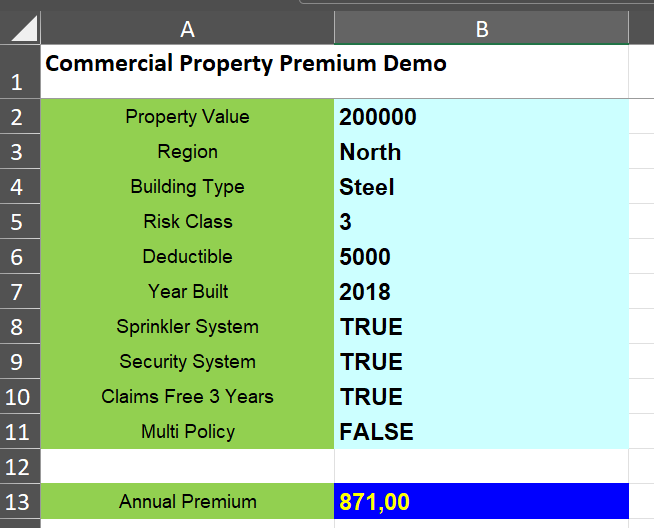
From Excel Rater To JSON API
CLE solves this problem by exposing rating models as production-ready APIs while allowing business teams to continue maintaining the underlying logic in Excel.
Applications submit JSON objects to the API. The rating model evaluates the request and returns the calculated results as JSON.
Example Input
POST /api/decision
Content-Type: application/json

[{
  "Property Value": 200000,
  "Region": "North",
  "Building Type": "Steel",
  "Risk Class": 3,
  "Deductible": 5000,
  ...
}]
Example Output
HTTP 200 OK

[{
  "Property Value": 200000,
  "Region": "North",
  "Building Type": "Steel",
  ...
  "Premium" : 871,
  "Eligible": true
}]
Applications do not need to understand premium factors, eligibility criteria, state-specific adjustments or product-specific calculations. They simply call the API and receive a consistent, auditable result. Whether the caller is a broker portal, underwriting workbench, policy administration system or customer application, every request executes the same decision model.
The Workbook Already Contains The Business Logic
Most rating models are not mathematical black boxes. They are collections of eligibility rules, lookup tables, classifications, premium factors and underwriting decisions that evolve over many years. Excel remains the preferred environment because domain experts can review, validate and modify this logic directly.
Premium calculations often depend on multiple risk factors, lookup tables and eligibility checks. Products differ across carriers, regions and distribution channels. New requirements constantly emerge as products evolve, regulations change and markets shift.
For this reason, Excel remains the preferred environment for many rating teams. It allows business experts to review formulas directly, modify rating tables, validate calculations and test new rules without depending on lengthy software development cycles.
Rather than treating Excel as documentation that must later be implemented elsewhere, CLE treats the workbook as the actual decision model.
Built For Rating Models
Most rating models consist primarily of conditional logic, lookup tables, factors and calculations. Premiums are rarely the result of a single formula. They are usually produced through a chain of decisions that combine multiple business rules, classification criteria and lookup operations.
CLE was built specifically for this category of decision models.
Whether the workbook calculates premiums, performs underwriting eligibility checks, assigns risk classifications, evaluates product suitability or generates recommendation scores, the execution pattern remains largely the same: inputs enter the model, business logic is evaluated and structured outputs are returned to the calling application.
This makes CLE a natural fit for organizations that already maintain rating models in Excel and want to reuse them consistently across multiple systems.
Eliminate Logic Drift
Logic drift is one of the most expensive and least visible problems in enterprise software.
A rating model may exist simultaneously inside an Excel workbook, a broker portal, a customer application and a policy administration system. Each implementation starts from the same business requirements, but over time those implementations begin to evolve independently.
Over time, inconsistencies begin to appear. A formula may be updated in one application while a product rule changes in another system, and a lookup table is modified somewhere else. Eventually identical inputs can produce different outputs depending on which application performs the calculation.
CLE eliminates this problem by centralizing execution. Regardless of whether a request originates from a broker portal, underwriting workbench or customer application, the same decision model is executed and the same version of business logic is applied throughout the entire landscape.
Rather than maintaining separate versions of rating logic across portals, underwriting systems, policy administration platforms and integrations, organizations can build the model once and execute it everywhere through a single API.
Excel remains the modeling environment. CLE becomes the execution layer.
Business Teams Stay In Control
Rating logic changes constantly. New products enter the market. Underwriting criteria evolve. Regulatory requirements appear. Distribution partners require specialized versions of existing products.
Traditional software implementations often turn these business changes into development projects. Every update requires technical interpretation, code changes, testing cycles and deployment processes.
CLE keeps ownership of business logic where it belongs.
Business experts continue maintaining rating models in Excel using a tool they already understand. Once a model is updated and published, applications automatically consume the new version through the API. This shortens delivery cycles while reducing the risk of misinterpreting business requirements during implementation.
The business owns decisions. The application simply consumes them.
JSON In. JSON Out.
CLE does not require organizations to redesign existing object models or adopt proprietary data structures.
Applications remain responsible for their own domain objects, workflows and business processes. CLE receives input data as JSON, evaluates the decision model and returns calculated outputs as JSON.
This approach keeps integration simple while allowing rating logic to evolve independently from application code. Existing systems can continue owning customer data, policy data and workflow orchestration without becoming responsible for implementing complex rating calculations.
Performance Without Spreadsheet Execution
Rating services frequently sit inside high-volume operational processes. Broker portals, quoting systems, underwriting applications and integration platforms all expect low latency and predictable performance.
Because CLE executes compiled dependency graphs rather than spreadsheets, the runtime is designed for production workloads instead of interactive spreadsheet usage. Applications call a stateless decision service that can be scaled independently from the systems consuming it.
This allows organizations to retain Excel as the modeling language while gaining the execution characteristics expected from modern API infrastructure. Because CLE executes compiled dependency graphs rather than spreadsheets, the runtime can process thousands of decision requests per second while remaining stateless and horizontally scalable.
Typical Use Cases
Insurance Rating API
Expose Excel-based premium calculations through a reusable API that can be consumed consistently across all customer, broker and internal systems.
Underwriting Eligibility API
Evaluate acceptance, rejection and referral decisions through configurable business logic maintained in Excel.
Risk Classification API
Assign risk classes, tiers and categories using centrally managed rating models.
Broker Quoting API
Provide brokers and distribution partners with real-time access to approved rating logic.
MGA Product APIs
Expose product logic maintained by underwriting teams through reusable JSON endpoints.
Rating Model API
Reuse a single rating model across multiple regions, brands, products or applications without creating parallel implementations.
Why CLE?
Most Excel-to-API platforms execute spreadsheets. CLE executes decisions.
The Excel workbook remains the modeling language. Business teams continue maintaining the logic they understand. Applications consume simple JSON APIs. Logic is not duplicated across systems, formulas are not reproduced in multiple codebases and rating decisions remain consistent everywhere they are executed.
Instead of treating Excel as a runtime environment, CLE treats Excel as source code. Excel workbooks are compiled into executable dependency graphs that become the runtime artifact.
The Excel workbook is the source code.
The dependency graph is the executable artifact.
CLE turns Excel rating models into production-ready APIs.