
Product Naming
Generate Consistent Product Names from Technical Attributes
Most organizations maintain thousands or even millions of products.
Product names are often created manually, resulting in inconsistent naming conventions, missing specifications and poor comparability across category pages, search results and product listings.
CLE allows organizations to define product naming rules in Excel and generate standardized product names automatically from technical attributes.
Business experts maintain naming rules. Applications consume generated product names.
Why Product Naming Matters
Product names are more than labels.
They are often the primary information customers see in:
- search results
- category pages
- comparison views
- product listings
- marketplaces
- procurement systems
If naming conventions are inconsistent, products become difficult to compare and search results become harder to understand.
Two technically similar products may appear completely different simply because they were named using different conventions.
Product Names Should Follow Rules
Many organizations already have naming standards.
For example:
- Product Type
- Input Voltage
- Power
- Number of Outputs
- Output Voltage
- Efficiency
- Manufacturer Part Number
The challenge is applying those rules consistently across thousands of products.
CLE executes naming rules centrally and ensures that every product follows the same structure.
From Technical Attributes to Product Names
Applications already contain the data required to generate a product name.
Technical attributes such as voltage, power, dimensions, outputs, efficiency or manufacturer part numbers are combined according to business-defined naming rules.
The result is a consistent product title that follows the same structure across the entire product catalog.
Product Attributes
POST /api/decision
Content-Type: application/json

[{
  "productType": "DC/DC Converter",
  "inputVoltage": "21.6-26.4 VDC",
  "power": "2 W",
  "outputs": 1,
  "outputVoltage": "5 VDC",
  "efficiency": "80 %",
  "manufacturerPartNumber": "1779405341"
}]
Generated Product Name
DC/DC Converter, 21.6-26.4 VDC, 2 W, 1 Output, 5 VDC, 80 % Efficiency, 1779405341
Applications send product data.
CLE returns a standardized product name.
Naming Rules Remain in Excel
Most naming requirements are business rules.
Different product categories often require different naming structures.
A sensor may require completely different naming components than a power supply, cable or valve.
Organizations therefore maintain category-specific naming models containing:
- field priorities
- naming sequences
- prefixes
- suffixes
- units
- category-specific rules
- conditional logic
- lookup tables
Real-world naming models often contain thousands of category-specific rules. Product categories require different naming sequences, optional attributes, units, prefixes, suffixes and formatting conventions.
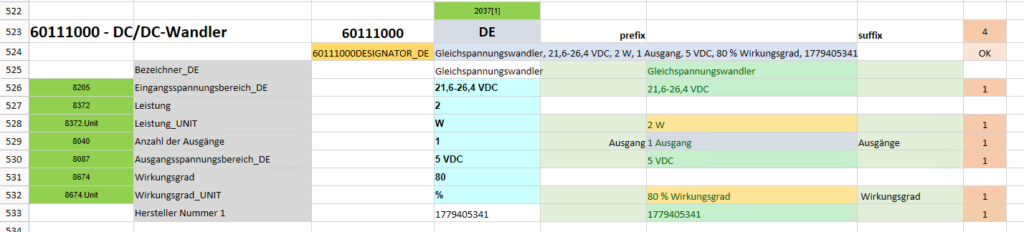
CLE allows these rules to remain in Excel.
No custom code.
No hardcoded templates.
No application-specific implementations.
Deterministic Product Naming Instead of AI
Unlike AI-generated product titles, deterministic naming models always produce identical results for identical inputs.
The same product data always generates the same product name.
This ensures:
- consistent search results
- better product comparison
- predictable outputs
- governed naming standards
- explainable results
Product names become a business decision rather than an editorial task.
Large Naming Models Are Business Assets
Real-world naming models often contain thousands of rules distributed across hundreds of product categories.
In one implementation, product naming rules for more than 500 product categories were maintained in a single Excel model containing over 10,000 rows of business logic developed and refined over many years.
Different categories require different naming conventions.
Different markets require different languages.
Different channels require different output formats.
CLE executes these models as reusable decision services while business experts continue maintaining the rules in Excel.
One Naming Model. Multiple Systems.
Generated product names can be reused across:
- PIM systems
- ERP systems
- Webshops
- Marketplaces
- Product catalogs
- Data feeds
- Procurement platforms
Every system receives the same result.
No duplicated naming logic.
No inconsistent product titles.
No synchronization projects.
Learn how CLE exposes product naming decisions through a Decision Engine API.
Why Organizations Use CLE For Product Naming
Consistent Product Titles
Ensure every product follows the same naming standard.
Excel-Based Rule Management
Maintain naming rules without software development.
Category-Specific Naming Models
Different product categories can follow different naming structures.
Deterministic Results
The same inputs always produce the same output.
Multi-System Reuse
Use one naming model across all applications.
Explainable Decisions
Every generated product title can be traced back to technical attributes and naming rules.
Product Naming as a Decision Service
Applications own the product data.
Business experts own the naming rules.
CLE executes the naming decision.
Keep the naming model. Replace the runtime.