
Business Decisions As APIs
Business decisions change faster than application code.
Most applications depend on pricing decisions, validation rules, classifications, approval paths, workflow routing and user interface behavior. The challenge is rarely defining these decisions. The challenge is making the same decision available consistently across ERP systems, portals, web applications, integrations and custom software.
CLE provides a REST-based Decision Engine API.
Applications submit business objects as JSON. CLE evaluates the decision model and returns the decision outcome.
Applications own the data.
Business experts own the decisions.
CLE exposes decisions through APIs.
What Is A Decision Engine API?
A Decision Service encapsulates business decision logic independently from application code. Applications send business context and receive decisions in real time.
CLE acts as a Decision Engine and exposes business decisions through reusable Decision Services and APIs. Instead of embedding business logic directly in application code, applications delegate decision-making to an external Decision Service.
Typical decision types include:
- Pricing decisions
- Product classification decisions
- Validation decisions
- Workflow decisions
- Approval decisions
- User interface decisions
- Product enrichment decisions
- Naming and description decisions
Applications remain responsible for data, users, integrations and business processes.
CLE becomes responsible for executing the decision model and delivering consistent decisions through a Decision Engine API.
The Problem With Hard-Coded Business Logic
Business logic rarely stays in one place.
- Pricing rules appear in ERP systems.
- Validation logic appears in portals.
- Classification rules appear in PIM systems.
- Approval decisions appear in workflow engines.
The same business decisions are often implemented repeatedly across multiple systems.
As a result:
- Rules become duplicated.
- Different systems produce different results.
- Changes require software releases.
- Business experts lose control over decision logic.
- Technical debt accumulates.
- Software upgrades become more difficult.
The problem is not the application.
The problem is executing the same business decision in multiple places.
How CLE Works
CLE separates business decisions from application code.
- Business experts model decisions in Excel.
- CLE compiles the decision model into an executable dependency graph.
- Applications invoke the Decision Engine API.
- CLE evaluates the executable dependency graph and returns the result.
flowchart TD

    MODEL["Excel Decision Model"]
    COMPILE["Compile"]
    GRAPH["Executable Dependency Graph"]

    JSONIN["Business Object (JSON)"]
    API["CLE Decision Runtime<br/>Decision Engine API"]
    JSONOUT["Enriched Business Object<br/>Decision Result (JSON)"]

    MODEL --> COMPILE
    COMPILE --> GRAPH

    JSONIN --> API
    GRAPH --> API
    API --> JSONOUT

    classDef model fill:#FFF9C4,stroke:#D4AF37,color:#000;
    classDef api fill:#FFDFE5,stroke:#FF5978,color:#8E2236;
    classDef data fill:#E3F2FD,stroke:#1976D2,color:#0D47A1;

    class MODEL,COMPILE,GRAPH model;
    class API api;
    class JSONIN,JSONOUT data;
Connected applications do not need to embed or maintain the shared decision logic themselves.
They simply consume the decision outcome.
JSON In. JSON Out.
Applications communicate with CLE using existing business objects.
Example request:
POST /api/decision
Content-Type: application/json

[{
  "customerGroup": "Retail",
  "articleGroup": "Spare Parts",
  "quantity": 250,
  "purchasePrice": 85.50
}]
CLE evaluates the decision model.
Example response:
HTTP 200 OK

[{
  "customerGroup": "Retail",
  "articleGroup": "Spare Parts",
  "quantity": 250,
  "purchasePrice": 85.50,
  "pricingFactor": 1.80,
  "salesPrice": 153.90,
  "approvalRequired": false
}]
The structure remains application-defined.
CLE does not prescribe a data model.
CLE evaluates the decision model and returns the attributes required by the consuming application.
CLE uses a bulk-oriented decision API.
Applications submit collections of business objects to a decision model. A collection may contain a single business object or thousands of business objects. The API pattern remains identical regardless of volume.
All business objects within a request are evaluated by the same decision model. A request may contain one object or thousands of objects of the same type. This allows complete product catalogs, order lines, validation tasks or user interface evaluations to be processed efficiently in a single API call.
One API Pattern. Many Decision Types.
The same integration pattern can be used for very different types of business decisions.
Pricing Decisions
Calculate prices, discounts, margins, quantity tiers and customer-specific conditions.
User Interface Decisions
Control field visibility, mandatory fields, editability and workflow behavior.
→ Explore Business Rules For User Interfaces
Product Classification Decisions
Determine product categories, taxonomies and classification attributes.
Validation Decisions
Evaluate completeness, plausibility and business constraints.
Workflow Decisions
Determine approval paths, routing decisions and escalation rules.
Product Enrichment Decisions
Calculate derived attributes and standardize product information.
Beyond Traditional Rule Engines
Traditional rule engines are often built around condition-action rules, decision tables and IF-THEN logic.
For many use cases this is sufficient.
Real business decisions, however, often combine:
- formulas
- lookup tables
- reference data
- pricing matrices
- classifications
- validations
- dependency chains
- intermediate calculations
A pricing model, for example, may use quantity tiers, customer groups, lookup tables, margin calculations and currency conversions within a single decision.
CLE follows a different approach.
Business experts model complete business decision models in Excel.
These models can contain IF statements, mathematical formulas, XLOOKUP, VLOOKUP, INDEX/MATCH, aggregation functions, text functions, date calculations and embedded decision tables.
CLE compiles the model into an executable dependency graph and exposes the resulting decisions through REST-based APIs.
CLE does not execute isolated rules. CLE executes complete business decision models.
Why Use A Decision Engine API?
Consistent Decisions Everywhere
Every application receives the same decision result.
No duplicated logic.
No inconsistent implementations.
Faster Business Changes
Business experts update the decision model.
Applications continue consuming the same API.
No software release is required for every rule change.
Lower Technical Debt
Business logic moves out of application code.
Applications become simpler and easier to maintain.
Better Business Ownership
Business experts maintain business decisions.
Developers maintain applications.
Responsibilities become clear.
Explainable Decisions
Every decision can be traced back to:
- Inputs
- Formulas
- Lookup tables
- Reference data
- Intermediate calculations
- Decision paths
Decision outcomes remain transparent and auditable.
Independent Application Evolution
Applications can evolve independently of the decision model.
Decision models can evolve independently of applications.
This reduces coupling between business logic and software development.
Excel As The Modeling Language
Most organizations already possess large amounts of business knowledge in Excel.
- Pricing logic.
- Classification logic.
- Validation rules.
- Approval logic.
- Calculation models.
- Decision tables.
CLE allows organizations to continue using these assets.
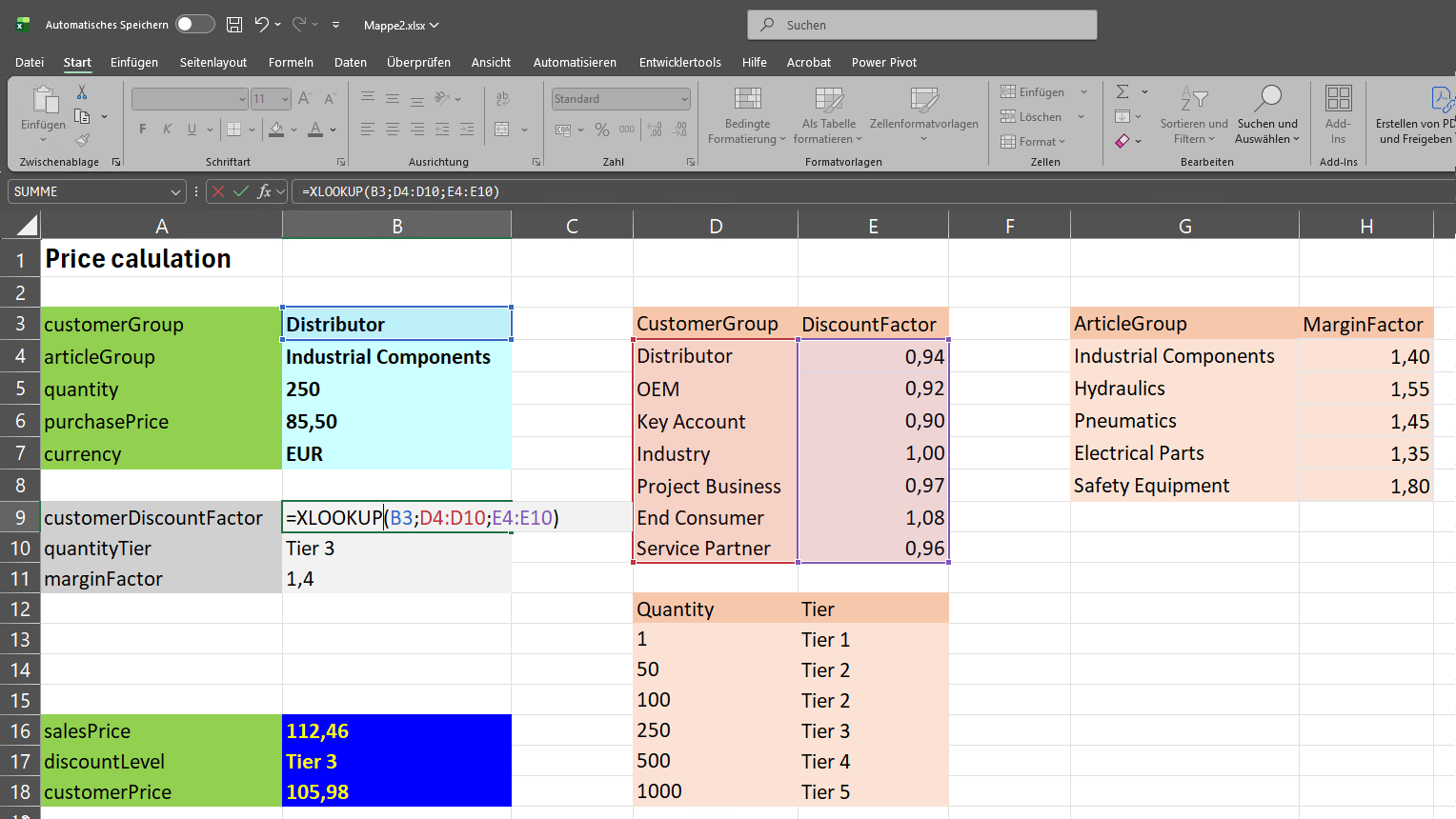
There is no need for:
- Proprietary rule languages
- Custom scripting languages
- Business rule migration projects
- New modeling tools
The Excel file remains the modeling environment. It is not the runtime.
The Excel file is the source code of the decision model.
The executable dependency graph is the runtime artifact.
One Decision Model. Many Applications.
The same decision model can provide decisions for:
- ERP systems
- PIM systems
- CRM platforms
- CPQ solutions
- E-Commerce platforms
- Customer portals
- Product configurators
- Mobile applications
- Custom software
Every application receives the same business decision.
No duplicated implementations.
No synchronization projects.
No inconsistent behavior.
Applications Own The Data. Business Experts Own The Decisions.
Applications should not have to duplicate business decisions that must remain consistent across multiple systems.
Applications own the data.
Business experts own the decisions.
CLE exposes business decisions through APIs.
Keep the application. Replace the hard-coded business logic.
Contact us to learn how CLE can expose your decision models through APIs.