
Decision Engine for Pimcore
Add Business Decisions To Pimcore
Pimcore manages product data.
Contene Logic Engine (CLE) executes business decisions.
When product data requires complex business decisions, organizations often implement rules in workflows, event listeners, custom PHP code, and integrations. Over time, business logic becomes scattered across the system.
CLE provides a centralized Decision Engine that executes business rules through APIs.
Pimcore owns the product data. CLE owns the decision logic.
Why Use An External Decision Engine With Pimcore?
Pimcore provides workflows, validations and lifecycle management for product data.
The challenge starts when decision logic must be shared across multiple systems.
A publication decision made in Pimcore often has to be applied consistently in ERP systems, e-commerce platforms, CPQ systems, marketplaces and custom applications.
Keeping the decision logic inside a single application creates duplicated rules, inconsistent results and increasing maintenance effort.
CLE centralizes decision logic and exposes it through APIs so that all systems execute the same business decisions.
The same decision can be executed by Pimcore, ERP systems, e-commerce platforms, CPQ applications and marketplaces.
Typical Pimcore Decision Engine Use Cases
Product Data Quality Scores
Evaluate product information and calculate:
- quality scores
- information levels
- completeness indexes
Publication Decisions
Determine:
- publishable
- not publishable
based on configurable business rules.
Product Approval Decisions
Approve product publication based on product status, data quality, compliance information, documentation and category-specific requirements.
Pricing Decisions
Calculate:
- customer-specific prices
- discounts
- margin rules
- approval thresholds
without embedding pricing logic into Pimcore customizations.
Source Priority Decisions
Determine which source wins when product attributes are provided by ERP systems, suppliers, marketplaces and external feeds.
Combine data from:
- suppliers
- ERP systems
- marketplaces
- external sources
and determine which values become part of the trusted product record.
How It Works
flowchart LR

    P[Pimcore]
    CLE[CLE Decision Engine]

    P -- "Pimcore Product Data" --> CLE

    CLE -- "Pricing Decision" --> P
    CLE -- "Publication Decision" --> P
    CLE -- "Quality Score" --> P
    CLE -- "Approval Status" --> P
Pimcore sends product data as a JSON object to the CLE Decision Engine API.
POST /api/decision
Content-Type: application/json

[{
  "country": "Italy",
  "weight": 205,
  "currency": "EUR",
  "requestedQuantity": 300,
  "purchasePrice": 1.35
}]
CLE evaluates the configured decision model and returns the decision as JSON.
HTTP 200 OK
(annotated for clarity)

[{
  "country": "ITALY",            // standardized
  "iso_code": "IT",              // added
  "weight": 205,
  "weightClass": "heavy",        // added
  "currency": "EUR",
  "requestedQuantity": 300,
  "purchasePrice": 1.35,
  "purchaseTier": 3,             // calculated
  "marginFactor": 1.81481,       // calculated
  "salesPrice": 2.45,            // calculated
  "qualityScore": 87,            // calculated
  "approvalStatus": "approved",  // calculated
  "isPublishable": true          // calculated
}]
Typical results include:
- quality scores
- approval statuses
- publication decisions
- pricing decisions
- validation results
Applications exchange JSON objects. CLE executes the decision logic.
Learn more about the Decision Engine API.
Pimcore Owns The Data. CLE Owns The Logic.
CLE does not replace Pimcore.
Pimcore remains responsible for:
- product data
- digital assets
- classifications
- workflows
CLE executes the business decisions behind the data.
Model Decisions In Excel
Business experts define and maintain decision models in Excel:
- scoring models
- pricing rules
- approval logic
- publication criteria
- validation rules
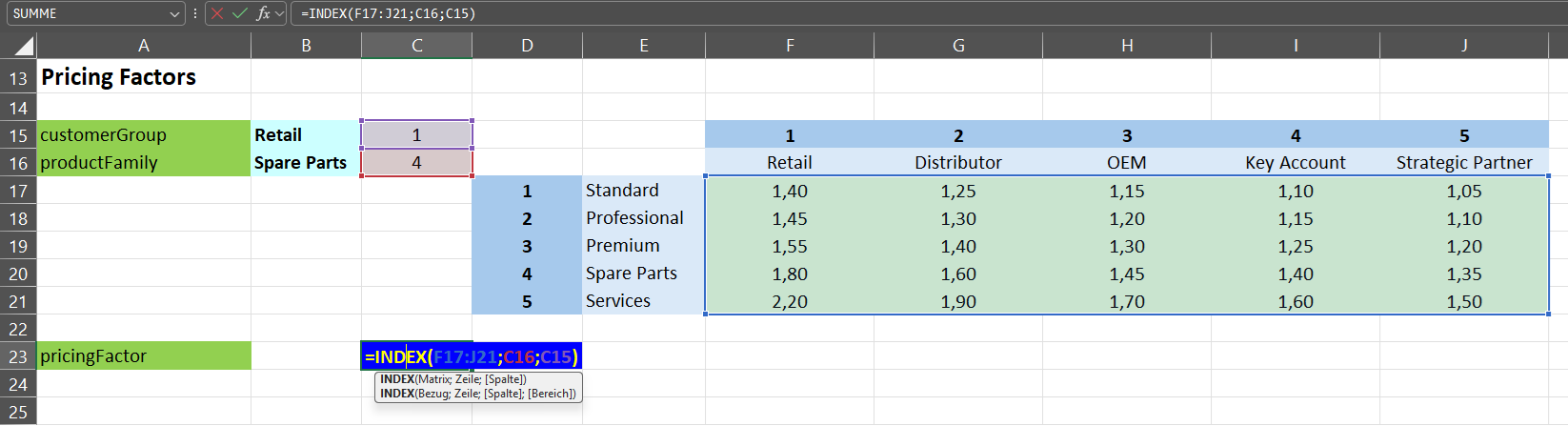
CLE compiles the models into executable decision graphs and exposes them as APIs.
Why Excel Instead Of Rule Editors?
Many decision engines require business users to rebuild their logic in proprietary rule editors, workflow designers or configuration interfaces.
For simple rules this may work well. In reality, many business decisions already exist in Excel and have evolved over years. Pricing models, publication decisions, quality scores and approval logic often contain hundreds of formulas, lookups, reference tables and business dependencies. Rebuilding these models in a rule editor creates a second implementation of the same logic.
CLE allows organizations to keep these decision models in Excel.
Business experts continue working in a familiar environment while applications consume the decisions through APIs.
Decision Logic And Business Rules For Pimcore
CLE acts as a centralized decision engine and business rules service for Pimcore. Instead of implementing business rules in workflows, custom PHP code, ERP systems and commerce platforms, organizations can centralize decision logic and expose it through APIs.
Developers build Pimcore applications.
Business experts define decision logic.
CLE executes the decision.
Keep Pimcore. Add a Decision Engine.